Training and certification
No Indonesian law requires recreational freedivers to hold a certification, or to train with a particular agency. Schools in Bali teach courses from AIDA, PADI, SSI, Molchanovs and others, and most will ask for a certification card before taking you on deeper line training or open-water trips.
Businesses are a different matter. A freediving school is a licensed diving-tourism business with its own operating standard. See running a freediving business.
The buddy rule
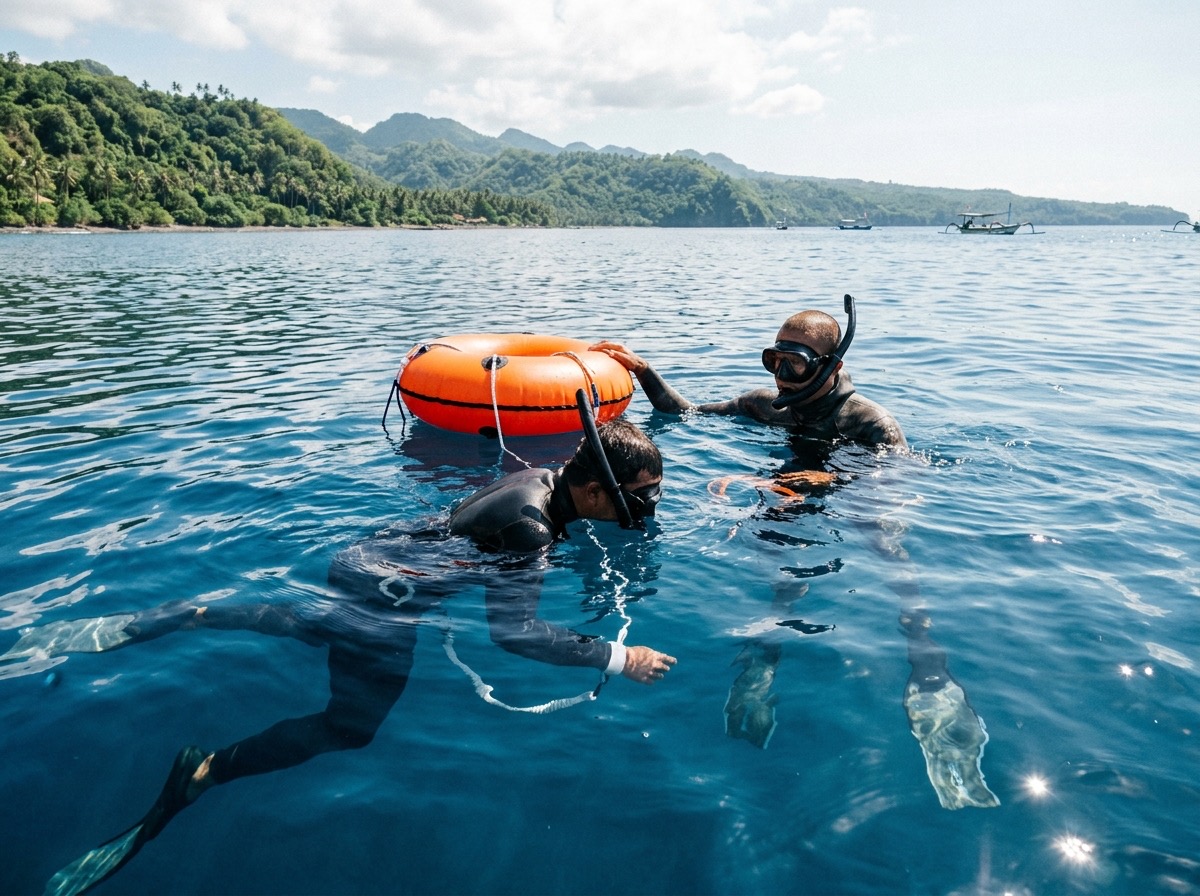
- Never freedive alone, including in shallow water. Most blackouts happen near or at the surface.
- One diver goes down while the other watches from the surface. The buddy stays with the diver for the last part of the ascent and watches for at least 30 seconds after they surface.
- Use a visible surface buoy with a dive flag, especially in Padang Bai and Amed, where boats pass close to shore.
- Do not hyperventilate before a dive, and rest for at least twice the length of your dive between dives.
Insurance
Insurance is not a legal requirement for tourists, but the German Embassy in Jakarta strongly recommends travel health insurance plus dive insurance that covers hyperbaric treatment and evacuation. Many standard travel policies exclude freediving below a set depth, so check the depth limit in the small print or buy specialist cover.
Hyperbaric chambers in Bali
Decompression illness is rare in freediving but possible with repeated deep dives. Lung and ear injuries also sometimes need hospital care. These hospitals in Bali are listed as having a hyperbaric chamber:
| Hospital | Location | Phone |
|---|---|---|
| Kasih Ibu Hospital Saba, Hyperbaric & Diving Medicine Center | Jl. Pantai Saba No. 9, Blahbatuh, Gianyar | +62 361 3003028 (hyperbaric) +62 361 3003333 (main) |
| RSUP Prof. Dr. I.G.N.G. Ngoerah (formerly Sanglah Hospital) | Jl. Diponegoro, Denpasar | +62 361 227912 |
Chamber availability changes. There is no chamber on Nusa Penida, and divers there are evacuated to mainland Bali by sea. Your dive operator should have an emergency plan. Ask about it before you get on the boat.
Source: German Embassy Jakarta, list of hyperbaric chambers in Indonesia (Oct 2023); Prof. Ngoerah Hospital.
Emergency numbers in Indonesia
| Service | Number |
|---|---|
| General emergency / police | 112 or 110 |
| Ambulance | 118 or 119 |
| Search and rescue (BASARNAS), including at sea | 115 |
| Fire | 113 |
| Natural disaster | 129 |
Source: Indonesian Ministry of Tourism, indonesia.travel.
Currents and conditions
- Nusa Penida: strong, fast-changing currents and cold thermoclines, especially in the mola mola season. Only freedive here from a boat with an experienced crew.
- Amed and Tulamben: usually more sheltered, which is why most courses run here. Swell and visibility still change with the season.
- Harbours and bays: watch out for boats. Use a buoy and flag, and never surface without looking up.
- Nyepi: the island shuts down for 24 hours (8 March 2027). Boats do not run and emergency response is limited, so do not dive.