1. Entry and visas
Freediving as a tourist is a normal holiday activity, so any visitor visa covers it. What no visitor visa covers is work. That includes teaching, guiding, or "helping out" at a dive centre in exchange for free courses.
All Indonesia arrival declaration
- One online form replaces the old arrival card, the customs declaration (e-CD) and the health declaration. You get a single QR code.
- It is free on the official portal allindonesia.imigrasi.go.id. You can submit it from 3 days before arrival.
- It has been required in Bali since 1 September 2025 and at every international airport since 1 October 2025. Avoid third-party sites that charge a "processing fee".
Sources: Directorate General of Immigration (Oct 2026); Wego (Jun 2026).
Visa exemption
Citizens of the 10 ASEAN countries and of Belarus, Brazil, Colombia, Hong Kong, Kazakhstan, Macau, Peru, Suriname and Türkiye can enter without a visa. The stay is 30 days, with the day you arrive counted as day 1. It cannot be extended or converted to another visa, and it does not allow work. The list was last changed on 9 July 2026.
Visa on arrival and e-VOA
- Costs IDR 500,000 and allows a 30-day stay. It can be extended once for another 30 days, so 60 days in total.
- Your passport must be valid for at least 6 months, and you need a return or onward ticket.
- It covers tourism, business meetings and transit. It does not allow work.
- Apply for the extension online no earlier than 14 days before your stay ends. Reports say an in-person visit to the immigration office is now part of the process.
In August 2026 the Director General of Immigration proposed raising the e-VOA to IDR 750,000 and the visa on arrival to IDR 1,000,000. At the time of writing this had not taken effect. Check the official price before you fly.
If you plan a longer freediving trip, the C1 tourist visit visa is arranged before travel. It gives 60 days and can be extended up to 180 days.
Sources: Visa policy of Indonesia (Oct 2026); Emerhub (2026); fee proposal report (Aug 2026). Official e-visa portal: evisa.imigrasi.go.id.
2. Bali tourist levy
- Amount: IDR 150,000 per foreign visitor, paid once per visit.
- How to pay: cashless only. The easiest way is online on Love Bali before you travel. You can also pay at airport and port counters or at registered hotels and attractions. Cards, bank transfer and QRIS are accepted, and you receive a voucher with a QR code by email.
- Who is exempt: diplomatic and official visa holders, transport crew, KITAS and KITAP holders, and student, family-reunion and Golden visa holders. Some exempt groups must apply for the exemption through Love Bali.
- Why it matters on dive trips: under the Governor's 2025 circular, tourist attractions may refuse entry to visitors who have not paid.
Legal basis: Law 15/2023 on Bali Province, Bali Regional Regulation 6/2023 (amended by 2/2025) and Governor Regulation 25/2025. Source: Love Bali FAQ (Oct 2026).
3. Working as a freediving instructor or guide
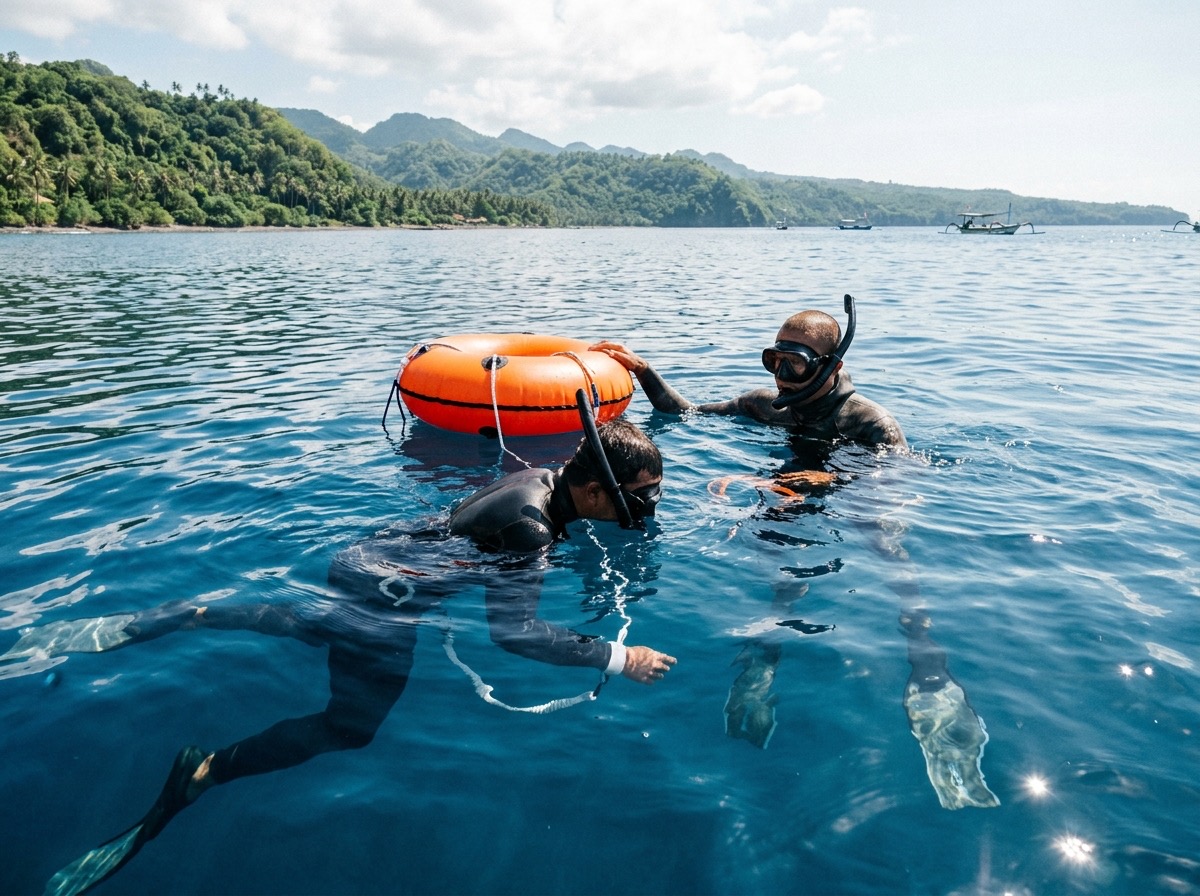
This is the area where foreign freedivers most often break the law without realising it. No visit visa allows work in Indonesia. That includes visa exemption, visas on arrival, the e-VOA, social and business visit visas and the remote-worker visa. A remote-worker permit lets you work for clients abroad, not for a Bali dive centre.
The legal route
- An Indonesian company sponsors you. It needs an approved foreign worker plan (RPTKA) from the Ministry of Manpower. The basis is Government Regulation 34/2021 and Manpower Ministry Regulation 8/2021.
- The sponsor pays the foreign worker levy (DKPTKA). Consultants put this at USD 100 per worker per month.
- You receive a work visa and then a limited stay permit (ITAS, often still called KITAS).
A 2021 guide to setting up dive centres in Bali says a dive company could sponsor permits for directors and managers but not for instructors. It also says investor or director permit holders may not teach. We could not confirm whether this still applies under the 2021 risk-based licensing reform. Ask an immigration lawyer before you accept a job offer.
What happens if you work illegally
- Misusing a stay permit is an offence under Law 6/2011 on Immigration. In practice the usual outcome is deportation plus an entry ban.
- In October 2024 a German national on an extended visa on arrival was deported for guiding divers at Tulamben. In February 2025 two Polish nationals on visas on arrival were caught guiding tourists.
- Bali immigration deported 342 foreigners in the first half of 2026, mostly for permit misuse and overstays. In September 2026 a remote-worker permit holder was deported for working locally as a motorcycle instructor.
Sources: Indonesian National Police (Oct 2024); Antara Bali (Feb 2025); RRI (Jul 2026); RRI (Sep 2026).
4. Running a freediving school or operator
- Business code: freediving falls under KBLI 93242 Wisata Selam (diving tourism), which explicitly includes snorkelling, freediving and sea walking. The Ministry of Tourism rates it medium-high risk. That means you need a business identification number (NIB) through the OSS system plus a verified standard certificate.
- Business standard: the operating standard for diving tourism is in Tourism Ministry Regulation 4/2021. It covers matters such as staffing, equipment and safety.
- Foreign-owned company (PMA): since 2 October 2025 (BKPM Regulation 5/2025) the minimum paid-up capital for a new PMA is IDR 2.5 billion, down from IDR 10 billion. Law firms disagree on whether the separate IDR 10 billion investment-plan test still applies.
- Foreign ownership limits: sources conflict. A 2021 guide cites a 49% cap for non-ASEAN investors in water tourism. Consultancies now list KBLI 93242 as open to foreign investment. Confirm in OSS before you invest.
- Other paperwork usually involved: company deed and Ministry of Law approval, a physical domicile office, a tax number (NPWP), tourism registration and environmental documents. Boats over 7 GT must be registered with the harbour authority.
The new KBLI 2025 list may have merged code 93242 into a broader water-tourism code (93297). Check the current code in OSS at the time you register.
Sources: SAH licensing note on KBLI 93242 (Dec 2022); Permenparekraf 4/2021; guide to setting up a dive centre (2021); law-firm summaries of BKPM Regulation 5/2025.
5. Marine protected areas and fees
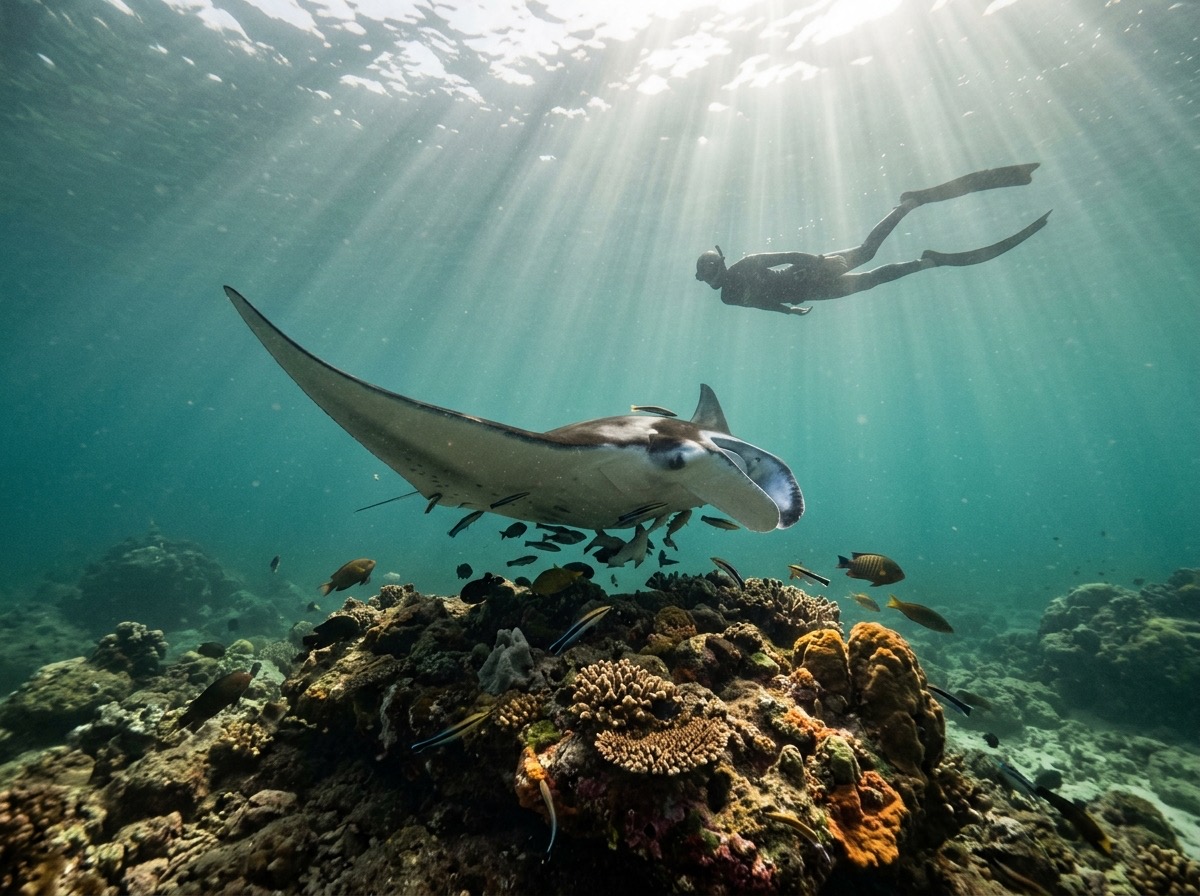
Nusa Penida Marine Protected Area
About 20,000 hectares around Nusa Penida, Nusa Lembongan and Nusa Ceningan have been protected since 2014 (Ministerial Decree 24/KEPMEN-KP/2014). The area is managed by the provincial marine authority.
| Visitor | Diving / snorkelling fee |
|---|---|
| Foreign adult | IDR 100,000 |
| Foreign child | IDR 50,000 |
| Indonesian adult | IDR 10,000 |
| Indonesian child | IDR 5,000 |
- The fee is set by Bali Regional Regulation 7/2021 and has been collected since 2023. We found no change since then. Your boat operator normally collects it.
- The park is zoned. Fishing and tourism are banned in the core zone. Fishing is banned in the marine tourism zone. In the sacred zones near coastal temples, diving is allowed only in marked areas.
- In 2023 the province said it planned to extend the levy to Amed, Tulamben and parts of Buleleng. We could not confirm whether it is collected there yet.
Sources: detikBali (Jul 2023); Antara Bali (Oct 2023); Mongabay on the zoning plan.
Menjangan Island and West Bali National Park
Menjangan lies inside West Bali National Park (Taman Nasional Bali Barat). Foreign visitors pay a park entrance fee, reported at around IDR 200,000 to 250,000, plus separate charges for the boat, guide and diving. Trips leave from Labuhan Lalang. Go with an operator who handles the permits.
Sources: Love Bali; Indonesia Travel (Ministry of Tourism).
6. Wildlife and coral law
- Manta rays: both reef and oceanic mantas, including all their body parts, have been fully protected since 2014 (Ministerial Decree 4/KEPMEN-KP/2014).
- Protected animals, including sea turtles: Law 5/1990 on conservation, as amended by Law 32/2024, makes it a crime to capture, kill, keep, transport or trade protected animals, alive or dead, or their parts. Legal commentary puts the penalty at 3 to 15 years in prison plus a fine. One parliamentary note cites 4 to 20 years.
- Coral: Law 27/2007 on coastal areas, as amended, prohibits taking coral in conservation areas and any destructive fishing on reefs. Do not stand on coral, and do not take coral, shells or rocks as souvenirs.
- Code of conduct in the Nusa Penida park: stay at least 3 metres from mantas and mola mola, never touch, hold or feed them, and never stand on coral.
Sources: WWF Indonesia; Hukumonline (Jul 2025); Law 27/2007, Art. 35.
7. Spearfishing and fishing
Fishing of any kind, including spearfishing, is banned in the core and marine tourism zones of the Nusa Penida park, and protected species may never be taken. We found no single national rule on recreational spearfishing for Bali, so ask your operator and the local village before you hunt anywhere. Never spearfish with scuba or a compressor, never inside a marine park, and never near a dive site where people are freediving.
8. Tourist conduct rules and Nyepi
Governor's Circular Letter 7/2025 replaced the 2023 "dos and don'ts" for visitors to Bali.
You must
- Respect temples, sacred sites and sacred statues
- Dress modestly away from the beach
- Pay the tourist levy
- Use certified guides at natural sites
- Use licensed money changers
- Follow traffic rules
You must not
- Enter the inner temple courtyards unless you are praying in traditional dress
- Climb sacred trees or monuments, or take nude photos
- Litter, including at sea, or use single-use plastic
- Work or run a business without permits
- Trade in drugs, protected animals or sacred objects
Bali's public order police (Satpol PP) enforce the circular. You can report a violation on WhatsApp at +62 812 8759 0999.
On the Balinese Day of Silence the whole island stops for 24 hours. In 2026 the airport closed and ferries to Lombok and Java were suspended. Do not plan diving, boat trips or travel that day. Hotels expect guests to stay inside. Details for 2027 are usually announced a few weeks ahead.
Sources: Bali Tourism Office (Apr 2025); 2027 national holiday decree (Sep 2026).
9. Drones and filming
- Commonly cited drone rules: a 150 m height limit, no flying within about 15 km of the airport (which covers Kuta, Seminyak and Jimbaran), daylight and line-of-sight only, and permission needed over temples.
- Personal underwater photos and video need no permit. For commercial shoots, such as brand content or paid client work, use a local licensed production company that can arrange the required permits.
Source: What's New Indonesia (May 2025). Check the Directorate General of Civil Aviation before flying.
10. Bringing your gear
Since June 2025 (Finance Ministry Regulation 34/2025), personal goods worth up to USD 500 per passenger enter duty-free. Above that, duty and taxes are charged on the excess. Fins, masks, wetsuits and weights you bring for your own use and take home again are treated as personal belongings. Keep receipts for expensive items such as carbon monofins and dive computers, and declare them if you are asked.
Source: GNV Consulting summary of PMK 34/2025 (Jun 2025). We found no specific rule for freediving equipment.
11. What is still unclear
We could not confirm the following in an official source. Treat any figure you see for them elsewhere with caution:
- whether the proposed visa on arrival fee rise has taken effect
- foreign ownership limits for diving businesses, and whether KBLI 2025 changed the business code
- whether dive companies can now sponsor work permits for instructors
- the official West Bali National Park tariff and any mandatory ranger rule
- whether the marine levy is collected in Amed and Tulamben, and any village (desa adat) fees there
- the legal protection status of mola mola
- details of the 2027 Nyepi closures
Spotted something out of date? Let us know and we will update the page.